


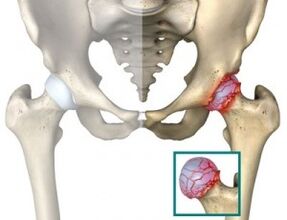
Coxarthrosis is a disease that affects the patient's hip joint.Treatment is long-term.Only a few decades ago, such a diagnosis could be said to be a death sentence for the patient, promising: severe debilitating pain, gradual loss of mobility, early disability.
But thanks to the most effective modern treatment methods, it has become possible not only to stop the degenerative process, but also to completely cure coxarthrosis at an early stage.
Understanding the causes of disease has given impetus to the use of an integrated approach in therapy.Treatment of arthrosis of the hip joint may include both drug and physiotherapeutic methods.
What is hip arthrosis?
Arthritis is a disease in which the normal structure of joint cartilage tissue is disturbed.Unlike arthritis, the cause of the deformation is not an infectious inflammation of the tissue, but a disturbance in the metabolic process.
Deformation of arthrosis of the hip joint, with rare exceptions, is observed in patients older than 40 years.Pathological development occurs as follows:
- Metabolism is disrupted.Cartilage tissue has no blood vessels, so its nutrition is provided by adjacent muscle tissue.For various reasons, the synthesis of substances is disrupted.
- Due to insufficient nutrition, cartilage begins to lose elasticity.Over time, it thins out.Interosseous clearance is significantly reduced.Arthrosis of the hip joint, grade 3, is characterized by the fact that growths on bone tissue rub against each other.Cartilaginous tissue is practically absent.
- The load on the bones and the decrease in the thickness of the cartilage contributes to the deformation of the bone tissue.
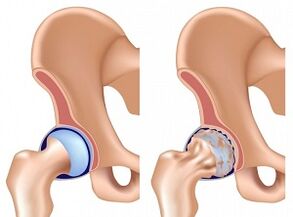
After the onset of degenerative changes, patients may take years to develop the third stage of the disease, but in unfavorable conditions and failure to take precautions, pathological changes can occur faster.
How does arthrosis manifest?
Symptoms of arthrosis of the hip joint and its nature depend on the level of development of the disease.The most characteristic symptom is pain.It is because of pain that patients most often turn to doctors for qualified help.Moreover, the dangerous disease is that in the early stages of degenerative changes, pain, as a rule, does not cause great inconvenience, is short-term and is often associated with normal fatigue.
The delay leads to the fact that the best time to start treatment is missed, and curing grade 2 hip arthrosis requires more time and effort.There is still a chance for a successful prognosis, provided the therapy is prescribed correctly.
Symptoms of the disease are:
- Pain can occur in the hip, groin area and in the joint itself.You should be careful if symptoms of pain appear during rest.This indicates the need for an immediate visit to an arthrologist.
- Stiffness of movement, lameness.It is observed after prolonged immobility of the legs, for example, after sleeping.
- Over time, the diseased leg becomes shorter than the healthy one, muscle tissue atrophy is observed, which can be felt during palpation.
Diagnosis of the disease cannot be done without modern diagnostic studies.Therefore, grade 1 hip arthrosis is diagnosed only using radiography, CT and MRI.The image clearly shows changes and narrowing of the interosseous space.
Stage of hip arthrosis
After diagnosing the pathology, the patient is assigned a code according to ICD 10. This is an international classification of diseases, which is revised every 10 years.
Thanks to the code provided, not only statistical data is collected.The therapy that has produced the most significant results can be selected.Thanks to international cooperation, the drug treatment of hip arthrosis has improved significantly over time.
In world practice, it is recognized that arthrosis of the hip joint has three stages or stages of development.Each of them has its own symptoms.That is:
- First stage.Painful sensations occur only against the background of excessive stress: running, exercising, exercising, etc.The pain is concentrated mainly in the joint area.Usually the pain goes away on its own after some time of rest.At the same time, leg mobility remains complete, muscle strength is not limited.First-degree arthrosis can only be diagnosed using radiography or tomography.The image clearly shows a slight deformation of the bone tissue that does not go beyond what is called the labrum.The joint space is slightly narrow, usually in uneven areas.
- Second stage.Migrating pain is characteristic, starting to spread to the groin and thigh area.Can occur spontaneously during rest.The pain due to arthrosis of the hip joint in the second stage does not go away by itself and requires the patient to take anesthetic.Range of motion is affected, and muscle tissue atrophy is observed.The image clearly shows bony growth and deformation of the femoral head.Perhaps the appearance of cysts in the most loaded part of the thigh - the acetabulum.Diagnosis of arthrosis in the second stage is carried out quickly.Even with a cursory examination, pathological changes are obvious.X-ray or MRI is ordered to see the extent of the defect.
- Third stage.The pain becomes chronic.Arthrosis can be determined even without a thorough examination.The patient cannot move without crutches;there is a pelvic tilt, which leads to shortening of the legs.When moving, the patient should lean his body towards the damaged joint.As a result, this leads to greater degenerative changes.Images show extensive bone deformation.The joint gap is almost invisible.
Therapeutic treatment of hip joint deformation arthrosis is only effective at stage 1-2 of the disease.The third stage of pathological development often leads to the need for surgical intervention.
How to treat arthrosis in the hip joint
Regardless of what is used, gymnastics for arthrosis of the hip joint or taking medications, all approaches are based on six basic principles.That is:
- Relieves pain.
- Ensure normal nutrition of cartilage tissue and, if possible, restore it.
- Increases blood flow to the affected area.
- Reduce stress on joints.
- Strengthens atrophied muscles.
- Restore joint mobility.
To achieve all six goals, it is necessary to use complex therapy.So, for example, by prescribing an injection into the joint, but without taking care to reduce the load on it, you can negate all the beneficial effects of chondroprotectors.It is not surprising that in world practice, from 2 to 10 different approaches are usually used simultaneously, depending on the patient's condition.
How to treat hip arthrosis
An integrated approach to the treatment of the hip joint gives better results compared to the use of only one therapeutic agent - this is a fact recognized by the world's leading arthrologists.Therefore, patients are often simultaneously prescribed several types of treatment from the following:
- NSAIDs- non-steroidal drugs to relieve the inflammatory process are "classic" treatments.Medicines for arthrosis of the hip joint must be prescribed either in combination with non-steroidal drugs or contain them in their composition.NSAIDs are particularly effective during exacerbations.Helps relieve pain and reduce swelling.The appointment made it possible to perform physical therapy exercises for arthrosis of the hip joint, moving to massage, gymnastics and other physiotherapeutic procedures.The downside of NSAIDs is their negative effect on the gastric mucosa.Patients need to understand that non-steroidal drugs for the treatment of hip arthrosis do not cure the disease, but only eliminate the symptoms, making therapy possible.
- Chondroprotectors and hyaluronic acid.These drugs are a new stage in the treatment of hip joints, so they can be divided into separate groups.
- Chondroprotectors are prescribed as rehabilitation therapy.With long-term use, chondroprotectors restore damaged cartilage tissue, but their effectiveness is limited to the early stages of the disease.
- Hyaluronic acid creates a layer between the bones, reducing the load on the joints.Effective as a rehabilitation therapy.
- Relax the muscles- is a vasodilator and allows you to relieve muscle tissue spasms.Designed to reduce the load on the joints.Muscle relaxants can only be used as part of complex drug therapy.
- Ointment relieves pain- despite the advertising that talks about ointments as a way to magically eliminate diseases, in fact they only eliminate unpleasant symptoms of the disease.On the other hand, painkillers in the form of ointments increase the effectiveness of conservative treatment, allowing you to relieve swelling and alleviate the patient's condition.
- Intra-articular injection- designed to relieve pain, restore cartilage tissue or provide protection from excessive pressure on the joint.The most commonly used are corticosteroids.They relieve pain, allowing patients to begin treatment with physical therapy.The corticosteroid group also includes hyaluronic acid preparations.The effectiveness of intra-articular injections largely depends on the experience of the surgeon (according to statistics, 30% of doctors miss the joint capsule when performing manipulations).
Some drugs can harm the body.Self-medication is strictly prohibited!
The hip joint bandage will relieve the load on the joint and reduce the factors that are the main cause of tissue irritation that leads to the inflammatory process.Therefore, along with drug therapy, fixation of the damaged area is often prescribed.
Non-traditional methods and physiotherapy
In addition to prescribing anti-inflammatory drugs, intra-articular injections and other drugs, patients can undergo physiotherapy and take advantage of alternative therapy methods.
- Manual therapy- this procedure has a gentler effect on the damaged tissue than hip joint massage for arthrosis.Any aggressive effect on the damaged area can easily trigger the beginning of the inflammatory process.In our area, we are not yet accustomed to manual therapy, but in the West it is widespread and is one of the official methods of therapy.
- Therapeutic exercisewith deforming arthrosis - a wide area where patients can choose between traditional and non-traditional methods.For hip arthrosis, Pilates, yoga, as well as water exercises and other methods to restore atrophied muscle function are popular.Physical education and moderate exercise, along with medication, have a positive effect and contribute to the patient's recovery.
- Traditional medicine- most arthrologists oppose this method as an independent therapy.And their opinion has a basis.A large number of patients, having refused traditional medical help, have caused themselves to become disabled.But under the supervision of the attending physician, effective treatment of hip joint arthrosis with folk remedies is quite possible.Most of the herbs and infusions used have anti-inflammatory and analgesic effects.Some medicinal preparations have serious contraindications, so before taking them, you should consult an arthrologist.Non-traditional folk methods for treating arthrosis of the hip joint are recommended to be used with caution.Some recipes not only do not contribute to improvement, but also lead to the opposite effect, causing accelerated destruction of cartilage.
- Homeopathy- helps normalize the synthesis of substances in the body.Homeopathy is very effective for post-traumatic arthrosis, allowing you to overcome the main factors that lead to the development of the disease.
- Apitherapy- treatment with bee stings is very effective, allowing you to combine the effects of acupuncture and drug therapy.It is not surprising that many warming and effective ointments contain processed bee venom.Often, the use of apitherapy is more effective than hip blocks.The suitability of using apitherapy should be decided by the attending physician.
- Magnetotherapy- used as an additional treatment and disease prevention.The magnetic effect increases blood flow to tissues and helps restore metabolic processes.Removes salt deposits.
- Hirudotherapy- Leech treatment has been used for centuries.It has been proven that leech saliva that enters the blood contains substances that help to thin it.As a result, blood can also enter capillaries and atrophy vessels.
- Mud therapy- has a mild warming effect, helps to obtain important nutrients.With the correct use of mud therapy, the inflammatory process and pain syndrome are reduced.Prohibited for purulent arthrosis of the hip joint.Prescribed with caution in the presence of blood clots and vascular disease.
- Shilajit for arthrosis- used in pure form and as part of tinctures and compresses.The beneficial substances contained in Mumiyo promote tissue regeneration.Mumiyo is very effective in the early stages of this disease.
- Massage yourself- sharp aggressive pop and pressure is eliminated.When massaging, it is necessary to ensure blood and lymph flow.An experienced chiropractor or massage therapist will show you the types of movements and their direction.
Treatment of arthrosis of the hip joint at home using unconventional methods must be supplemented with proper nutrition.
Losing just 5 kg will reduce the likelihood of an inflammatory process by about 30%.
Arthrosis of the hip joint and pregnancy
Pregnancy with arthrosis of the hip joint is a double stress for the female body.Taking most medications during pregnancy is prohibited.At least, they must be taken carefully so as not to harm the child.
If hip arthrosis during pregnancy is at an early stage, drug treatment is recommended to be delayed until after delivery.
It is possible to give birth with arthrosis of the hip joint, but you need to understand all the risks associated with it.Complications after the birth of a child are not uncommon, and cartilage tissue deformation occurs at an accelerated rate.
Even when planning a child, it is necessary to undergo a complete examination of the body.All medicines, ointments, and pain relievers can only be taken as prescribed by a doctor.
As a result of arthrosis
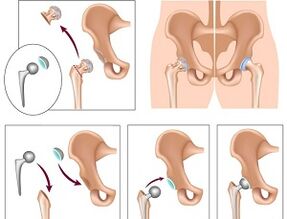
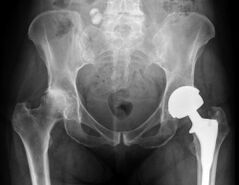
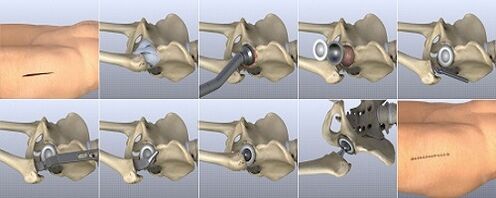
In the final stages of the disease, it becomes impossible to cure coxarthrosis in the usual way.Immediate surgical intervention is required.Surgery is a last resort and can be done in different ways.
- Joint replacement- fully restore all motor functions.The disadvantage of the solution is the limited period of use of the prosthesis.On average, after 15 years, a second operation is needed to replace it.
- Laser therapy for managed arthrosiship joint - used in case of rejection of the articular part of the bone.Using laser therapy, the damaged surface is removed and replaced with an artificial insert.
All types of surgical interventions are temporary, but without them the patient becomes disabled.
Early diagnosis of coxarthrosis and a properly prescribed course of rehabilitation therapy are the only reliable ways to combat this disease.Ignoring symptoms leads to disability.